The Savoy Gold Ratio
Dr. George Cooper
Chief Investment Officer
Jan. 30, 2026
Late last year, in one of Equitile’s board meetings, the conversation turned to the price of gold. Given our substantial investments in gold mining companies, this happens regularly. At the meeting, Gerald Ashley, one of our directors and my co-host on the Equitile Conversations podcast, recalled the long-forgotten story of Julian Baring’s "Savoy Gold Ratio".
In the 1980s and 1990s, Julian Baring was one of the City of London’s more famous fund managers; he specialised in managing funds of gold mining companies. As a light-hearted way to illustrate to his investors how the purchasing power of gold was changing over time, he would occasionally report on what he called the Savoy Gold Ratio. He would have dinner at the famous Savoy Grill restaurant on The Strand, and then, in his investor letters, he would report how much the dinner cost in terms of the prevailing price of a gold Sovereign. Specifically, he reported how much of a gold Sovereign it had cost him to buy dinner for two at the Savoy.
When Gerald recounted Julian Baring’s quirky story, it occurred to me that it would be a bit of fun—and hopefully a little educational—to resurrect the Savoy Gold Ratio. The aim was first to see how the purchasing power of gold had fared over past decades, especially since President Nixon took the world off the gold standard, and thereafter to see how its purchasing power changes in future years.
We all know the price of gold has risen sharply since August 15th, 1971, when the gold standard ended, but we also know the price of almost everything else has risen over the same period. What is not immediately obvious is to what degree the value of gold has fallen behind or outpaced the rising cost of living.
After Gerald recounted the story, we quickly hatched a plan to relaunch the Savoy Gold Ratio. We decided on an inaugural dinner at the Savoy Grill in January of this year and thereafter to repeat the exercise on a roughly annual basis. This open-ended commitment to repetitive fine dining is a burden, but one we feel we must bear in the interest of monetary research.
The dinner was held on January 7th, 2026, and we were joined for the occasion by the eminent economist Douglas McWilliams, who was also a recent guest on our podcast.
We are told Julian Baring reported his Savoy Gold Ratio as the number of gold Sovereigns it took to buy dinner for two. On the day of our dinner, the Royal Mint was quoting the price of a gold Sovereign at £817.81; tellingly, they were sold out. These days, few people follow the price of a gold Sovereign, so we have modernised the metric and chosen to express our Savoy Gold Ratio as the number of dinners at the Savoy Grill that can be bought for one ounce of gold.
On January 7th, 2026, gold was trading at $4,460 an ounce and the prevailing GBP/USD exchange rate was 1.35. Thus, an ounce of gold was worth £3,303 on that day. The dinner cost £236.32 per head, after choosing from close to the bottom of a ferociously expensive wine list! Therefore:
On the 7th of January 2026, an ounce of gold bought 13.98 dinners at the Savoy Grill.
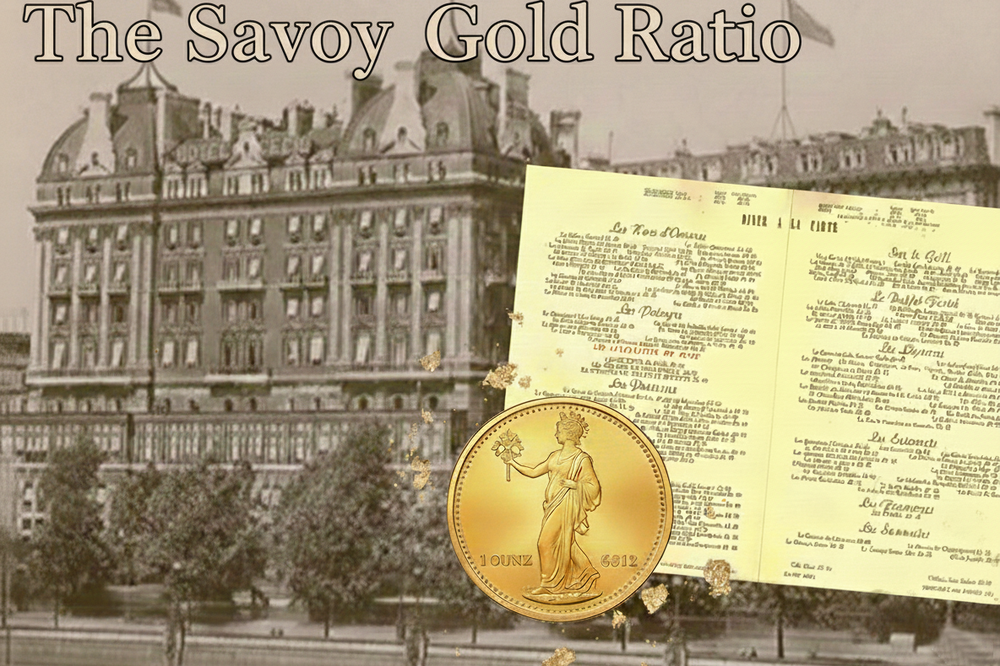
We were lucky enough to find a copy of a complete Savoy Grill menu from August 19th, 1971. For our purposes, the date of this menu was especially fortunate, being just five days after President Nixon ended the gold standard on August 15th, 1971. This menu allowed us to accurately calculate the cost of a comparable dinner at The Savoy Grill in 1971, at the very start of the modern fiat monetary regime.
From the 1971 menu, we estimated the cost of a comparable dinner, after the addition of the appropriate tip, to be £5.67 a head. The price of gold on that day we have taken as $40 an ounce, and at the time the GBP/USD exchange rate was pegged at 2.4. This makes the Sterling price of an ounce of gold £16.66. Therefore:
On the 19th of August 1971, an ounce of gold bought 2.94 dinners at the Savoy Grill.
According to our Savoy Gold Ratio, over the 54.4 years of the modern fiat money regime, the purchasing power of gold has risen 4.75-fold. This translates into a rather healthy 3% annual increase in real spending power of gold. We are surprised how high this figure is.
Of course, these two data points say nothing about how the purchasing power of gold will fare in the future—all the usual risk warnings apply—and the returns have suffered some wild gyrations over the five decades.
We can deduce a few other useful data points from this exercise:
- From 1971 to 2026, the price of dinner at the Savoy Grill increased 41-fold. This converts to an average annual inflation rate of 7.1%. We suspect this figure is much closer to the inflation level people perceive than the officially published inflation figures or the 2% inflation target that the Bank of England claims to be targeting.
- The Office for National Statistics reports the average weekly wage in England was £20 in 1971 and is now £736. Using these figures, dinner at The Savoy Grill cost 1.42 days of wages in 1971 and a very similar 1.6 days of wages today. On this basis, perhaps The Savoy Grill is a reasonable barometer of the cost of living.
Unfortunately, from the data we have, we cannot say if today’s Savoy Gold Ratio of 13.98 indicates the current gold price is unreasonably high. This is because our only reference point is from 1971, when we know the gold price was unreasonably low; this is why President Nixon was forced to abandon the gold standard and to devalue the US dollar against gold.
Just prior to President Nixon’s 1971 Dollar devaluation, gold was pegged at $35 per ounce; by the end of 1974 gold was trading at $183, a 5.2-fold increase. By 1980, it was trading at $850, a 24.3-fold increase in approximately a decade.
We suspect the current movement in gold is reflecting another bout of monetary debasement akin to that which happened in the decade from 1971. From mid-2020 to end-2024, gold traded at around $2,000 an ounce. If we take the end of 2024 as the start of this new phase of debasement, and we use $2,000 an ounce as our reference level, repeating the 1970s would suggest $10,000 an ounce by roughly 2028, and a staggering $48,000 an ounce by 2034. These are not forecasts; rather, they are reminders of the magnitude of what can happen in periods of fiat currency debasement, and there are many historic debasements far more dramatic than those of the US Dollar in the 1970s.
For those interested in this story, The Times newspaper recently wrote about our endeavours: "An ounce of gold now buys dinner for 14 at the Savoy.”
You may also enjoy...
 View the Full List

Newsletter
Stay up to date with the latest insights, market commentary and company news from Equitile. We'll also send you our monthly Resilience Fund Report.
Equitile Conversations Podcast 🎙️
Join George Cooper and Gerald Ashley (plus special guests) as they discuss Markets, Risk, Macroeconomics, and Geopolitics on the Equitile Conversations Podcast.




We value your privacy
We use cookies to provide and secure our website, as well as analyse the usage of our website.